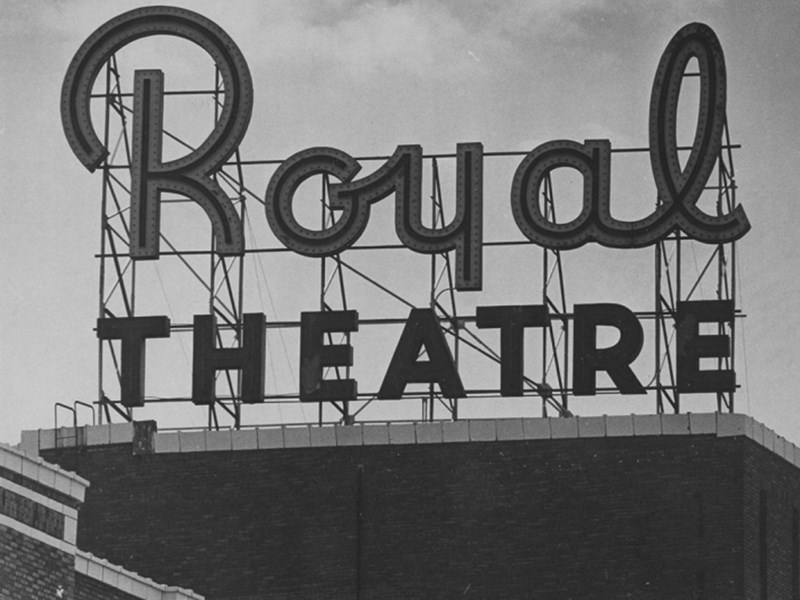
Royal Theatre History
The first part of the 20th century saw grand plans drafted for a theatre surrounded by retail space and apartments. In January 1912, the Victoria Opera House Company incorporated with seven directors under President Simon Leiser. Originally from Germany, Leiser was also president of the Victoria Board of Trade and owner of a large wholesale grocery company. Other members were J.S.H. Matson, publisher of the Daily Colonist newspaper, and lawyer R.T. Elliott, who would later be part of the planning for the new Pantages Theatre (McPherson Playhouse).
The building was designed by architects Rochfort and Eben W. Sankey, in conjunction with William Kingsley. Having already designed theatres in Seattle, Portland and Spokane, they were ready for the challenge. They planned a theatre that would have the largest stage this side of San Francisco and have upholstered tobacco brown leather seats that were the widest in North America.
Contractors Pinner and McLennan started construction in the spring of 1913. The original cost estimate was $250,000 but soared to over $400,000 due in part to the opulent interior. The directors visited many theatres during the planning stages and based their choice on a design similar to the Orpheum Theatre in Seattle. To raise funds, $5 shares were offered and the local community made generous donations of cash and supplies.
The Royal Theatre opened its doors with a capacity to seat 1,558 patrons. Unlike many vaudeville theatres of the day, the theatre offered a fully functional orchestra pit and an unobstructed view of the stage on the main floor. To realize this unobstructed view a cantilevered balcony was installed with a massive I–beam shipped to Victoria from the United Kingdom around Cape Horn at the bottom of South America.
The ornate interior was composed of marble, blue brocade wall panels and numerous examples of scagliola. Allegorical murals and frescoes were designed by Paris-born C.E. Dorisy and executed by his team of artists. The exterior of the Royal Theatre was designed in a Rococo/Renaissance revival style with four storeys of multi-coloured brickwork, glazed terra cotta tiles and decorative and whimsical ornamentation. A Tiffany style awning graced the entrance but was later replaced by newer versions during various renovations. The simple design of the sides of the Royal, most notably the Blanshard Street view, reflects the fact that other attached construction was initially planned.
The premier of British Columbia, Sir Richard McBride, was a keen supporter of the project and many of the original drawings are of the “McBride Theatre”. The premier gracefully declined the honour of having the building named after him and the decision was made to christen it the Royal Theatre. It was an odd choice, as typically a member of the Royal family must visit the venue for this to occur.
The opening gala took place on December 29, 1913 and featured a performance of Kismet starring Otis Skinner as the poet Hajj. Skinner, considered to be the leading actor of his time, was quoted as saying, “It is without question the finest theatre in the Dominion of Canada, and in fact, there are very few to equal it on this continent”. As the final building inspections had yet to be completed, the City of Victoria is on record as the owner for the first performances. The first local production was The Gondoliers, by the Victoria Amateur Operatic Society, in January 1914.
Unfortunately with the start of the First World War and the increased popularity of motion pictures, the Royal fell on hard times and in January 1916, the theatre was forced into foreclosure. The mortgagee hung a screen over the proscenium arch to show Birth of a Nation, an American silent epic drama directed by D. W. Griffith.
The lease for the Royal Theatre passed between several theatre companies until the title was finally transferred to the Royal Victoria Theatre Company Limited in November of 1928. Over the next sixteen years, the Royal hosted numerous firsts for the City of Victoria, including Dorothy Wilson’s full-length North American premiere ballet production of Coppelia. During this time, the newly formed Victoria Symphony Orchestra made its’ debut and the Victoria Opera Society began performing on the Royal stage.
In 1943, the Royal Theatre officially became a moving picture house showing films as well as live performances. In the following years, the original red and gold grandeur was replaced by neutral colours and at the same time a new projection booth was added requiring the removal of numerous seats in the balcony. By 1957, Famous Players obtained the title to the theatre and the debate regarding the future of the building started. Over the next twelve years, updates to electrical systems were undertaken and remodeling of the concession was completed. Despite these improvements, Famous Players felt that the building was coming to the end of its lifespan. During this time, Victoria Mayor Peter Pollen became a strong advocate for saving the theatre and returning it to its former role as a performing arts theatre.
Interestingly, during renovations in the 1980’s a large portion of brick at street level was threatening to collapse leading to an investigation. It was discovered that the void the brick was covering was originally used as an entrance during construction for donkeys pulling carts loaded with wet concrete. It had barely set when the first audience was welcomed!
In 1973 Famous Players sold the theatre to the municipalities of Victoria, Saanich and Oak Bay, with the Capital Regional District assuming ownership in trust. Famous Players continued to lease the building until 1982. Numerous improvements were needed in order for the Royal to return to hosting live performances so the old lighting and sound systems were replaced and a new acoustic shell was installed to allow a more contemporary audio and visual experience. Management of the theatre was taken over by the McPherson Foundation, eventually evolving into the Royal and McPherson Theatres Society in 1998. The RMTS continues to manage the theatre along with its sister facility, the McPherson Playhouse.
The original foyer was augmented by lobby extensions completed in 1991. The new additions also doubled as exterior support buttresses for the original structure. Despite the contemporary lobby additions, the auditorium continued to retain its original Rococo/Renaissance revival style décor. Extensive technical upgrades, restoration work to the auditorium, and refurbishment of the dressing rooms along with the installation of new seating was completed in 2002. The Royal Theatre also had a complete restoration of the façade in 2006. Through research and hours of detailed restoration plates, cherubs, and other creatures were restored and in some cases recast to match the original terra cotta features. This thoughtful restoration earned awards from the Hallmark Society and the Heritage Canada Foundation.
The Royal Theatre became a site of national historic significance in 1987. It was officially designated a National Historic Site of Canada on May 12, 1988. In 1990 the Royal Theatre received a commemorative plaque from the Historic Sites and Monuments Board of Canada.
Royal Theatre Vintage Image Gallery